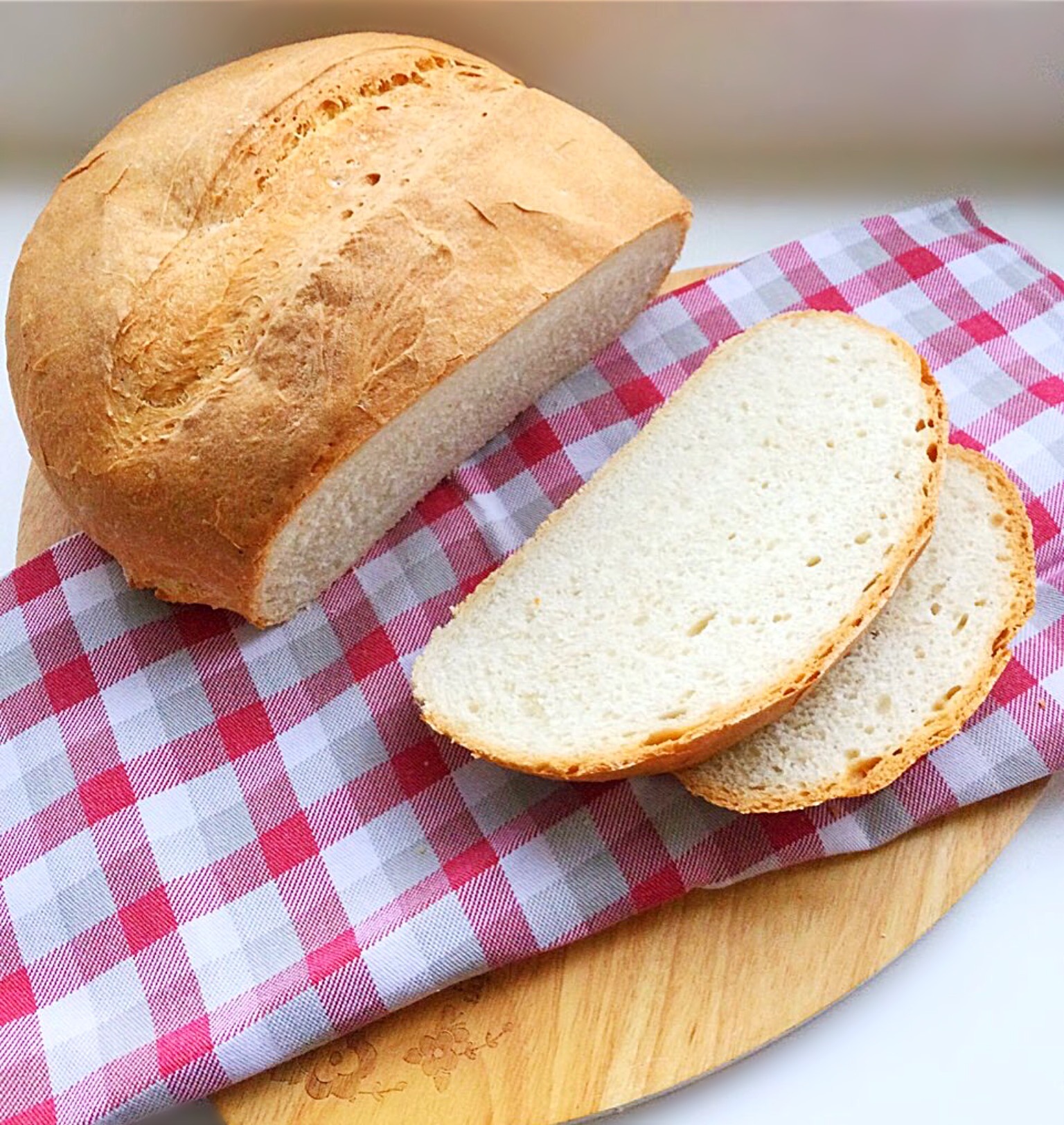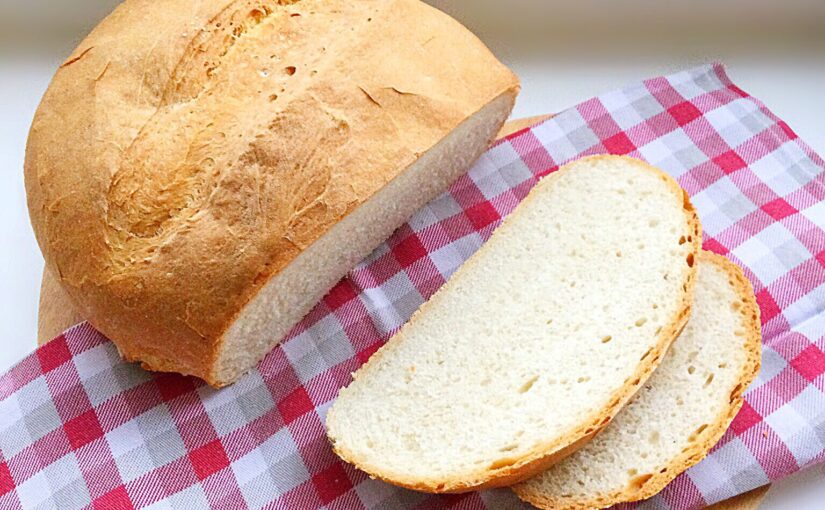
Easy White Cob Loaf

Welcome to Autumn here in the U.K. A time when storms rip across the land, pulling leaves from trees, tousling our manicured summer gardens. While shadows lengthen as the days shorten and golden sunshine illuminates the changing colours of our landscape. As temperatures begin to drop thoughts turn to indoors where we crave comfort and being cosy. The kitchen, no longer churning out endless salads that quench summer heat, now become our sanctuary. And baking bread again becomes a pleasure, as the house fills with welcoming aromas and our appetites are satiated. Crusty and delicious this Easy White Cob Loaf is the simplest bread to make, requiring no special tin to bake it in.
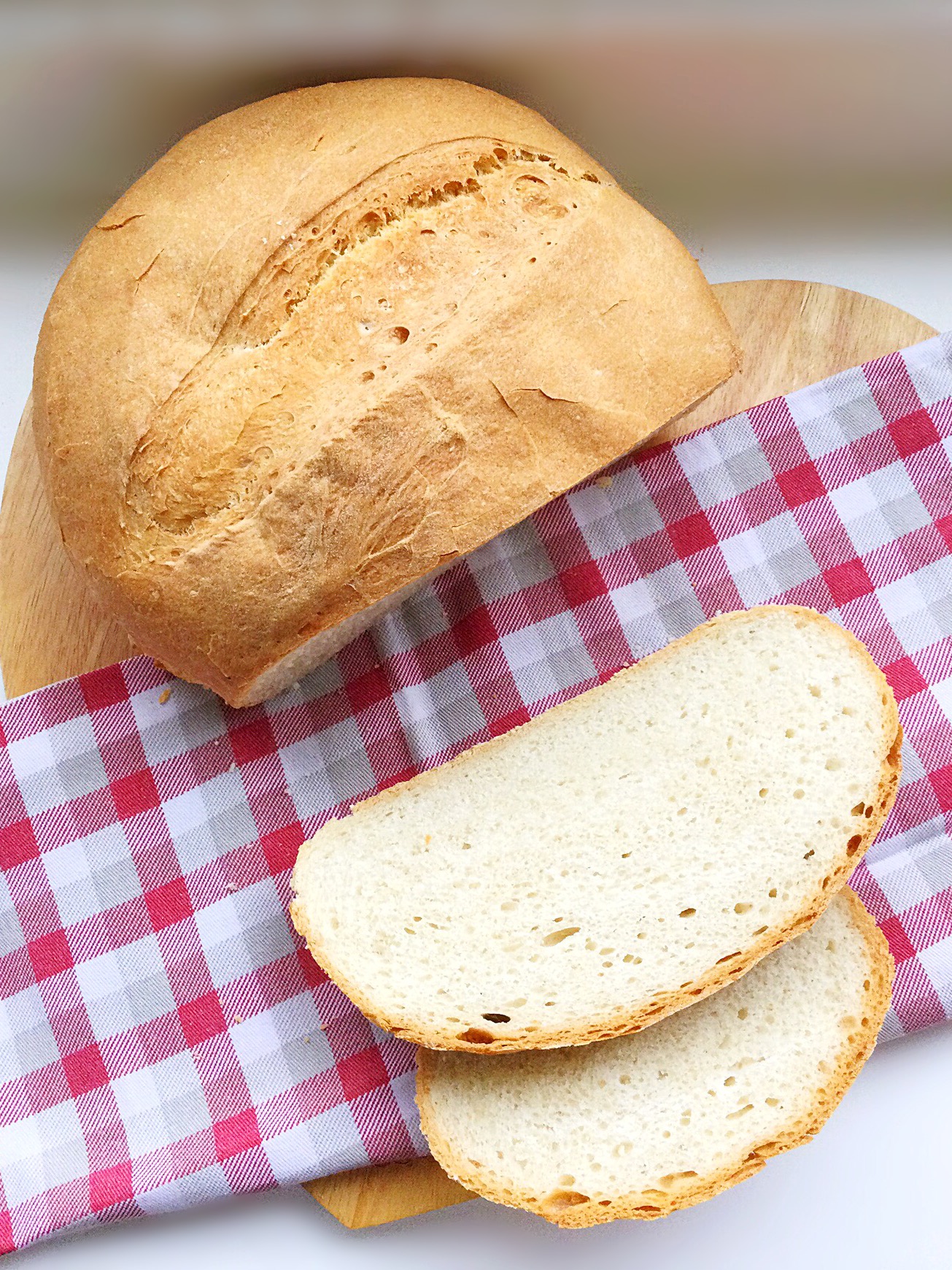
Cut loaf of bread on a board.

Taking The Hard Work Out Of Making Bread

Crusty bread is so appealing. Whether toasted and slathered in jam, or buttered and served with soup, it never fails to deliver on taste and texture. Made using simple ingredients; flour, water, yeast, salt and a little butter or oil, it only requires the minimum handling when using a stand mixer to mix and knead the dough. So, for those who struggle with painful hands due to arthritis, as I do, this recipe is simple and easy to make. Alternatively, this recipe can easily be made by hand for those who prefer to knead bread themselves.
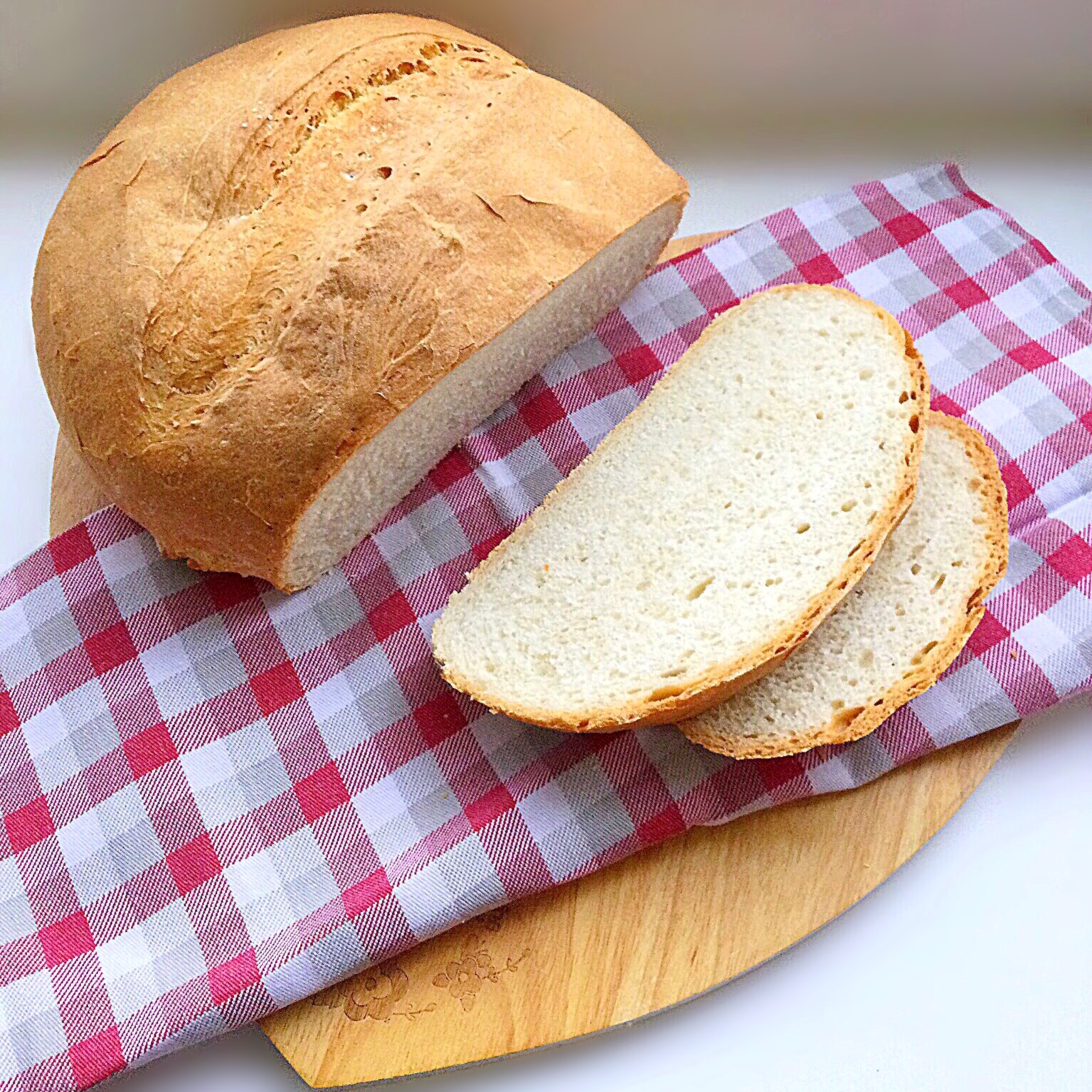
Sliced crusty white bread on a wooden board.

Easy Bread Making For Everyone

Whether this is your first time making bread or the millionth, the simplicity of this recipe is so rewarding. Since we use the same bowl to mix the ingredients together and prove the dough. And when using a stand mixer all of the kneading also takes place in this bowl. A baking tray is necessary and a dough scraper recommended. Finally, a sharp knife to score the dough and you’re all set!

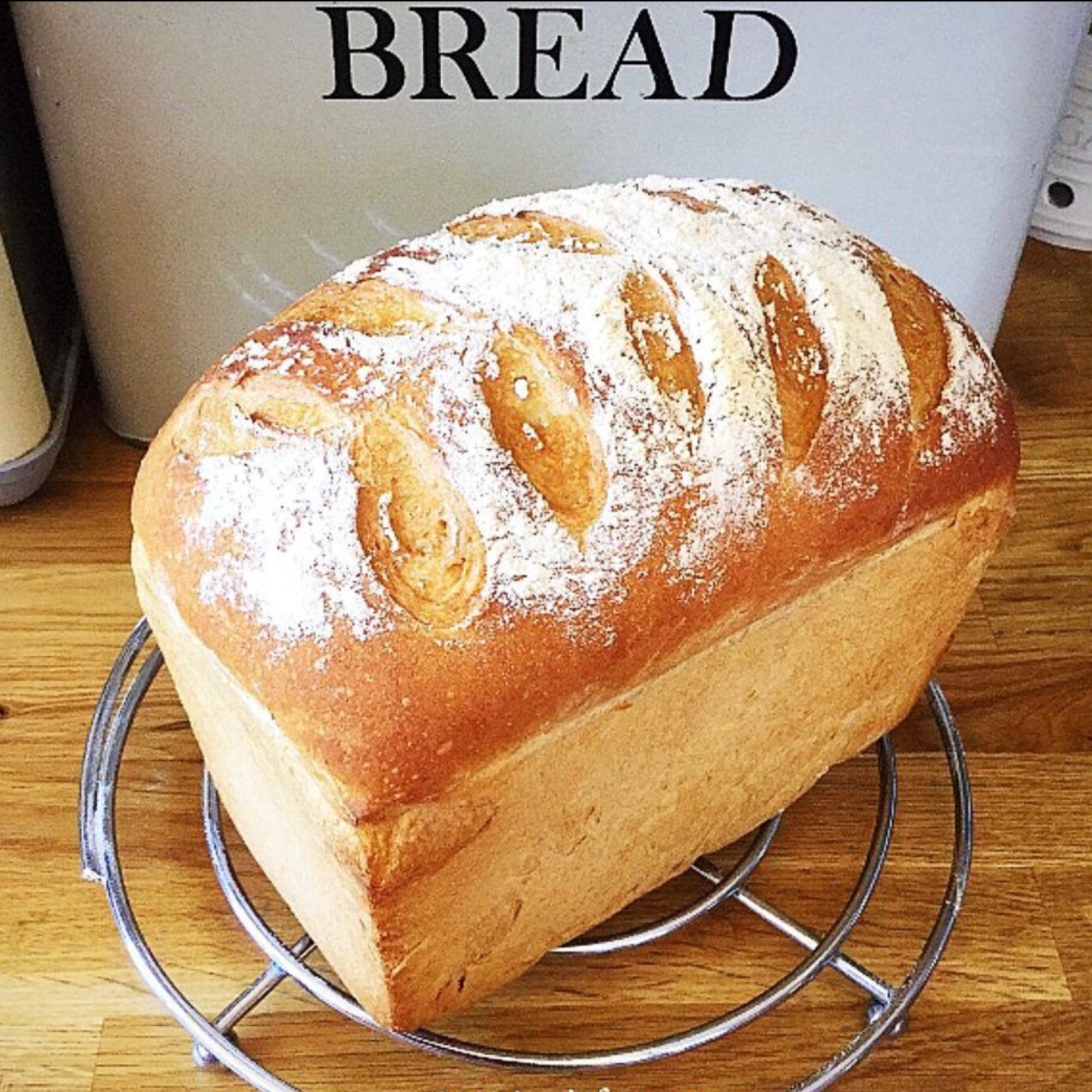
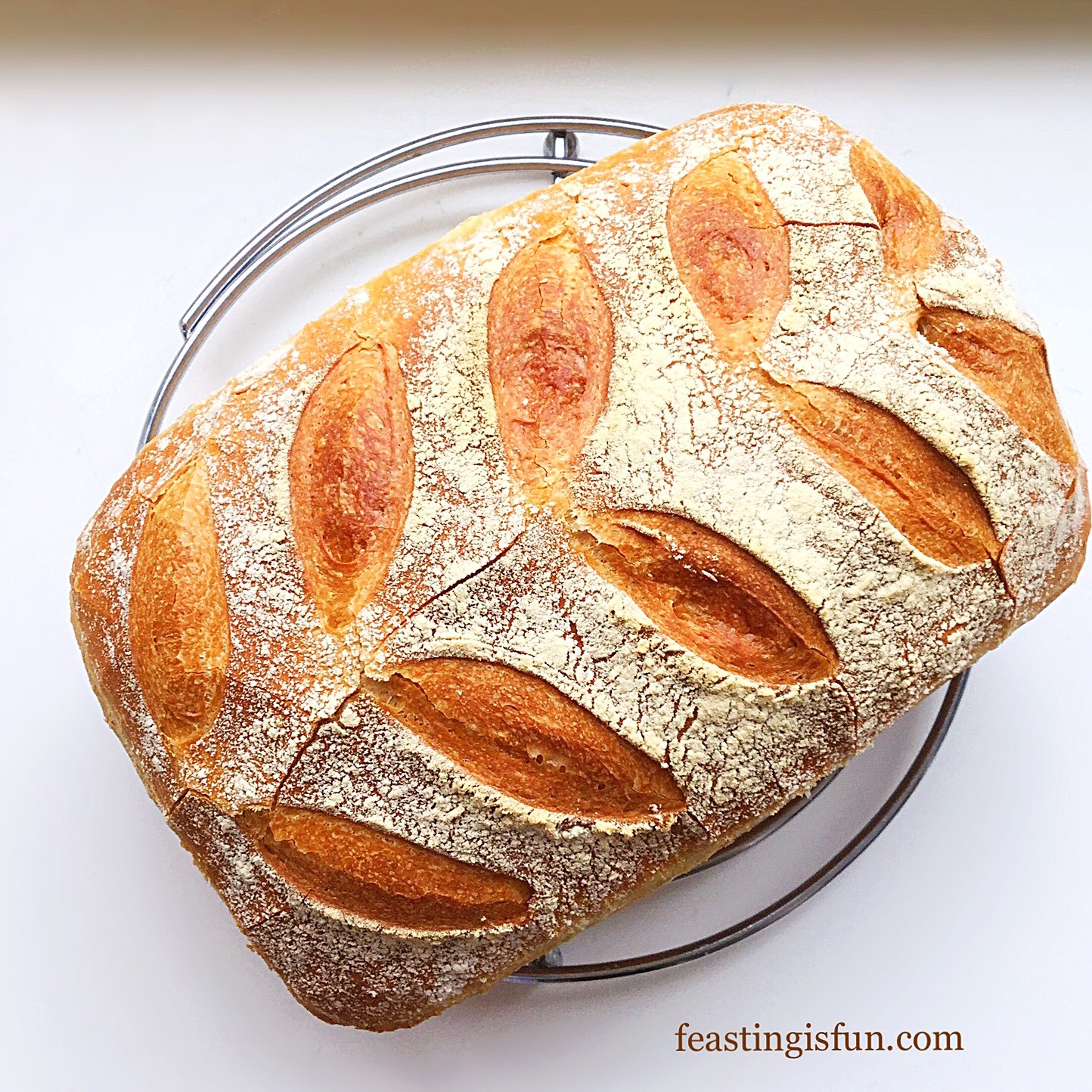
Easy White Cob Loaf freshly baked and cooling on a round trivet.

A beautiful, golden, crusty Cob Loaf.

Recipe: Easy White Cob Loaf

400ml/13.5fl oz  Water at body temperature 37C/98.5F

7g  Fast Action Dried Yeast – I currently use Doves Farm

600g/1lb 5oz Strong White Bread Flour – I use Organic White Bread Flour from Shipton Mill plus a little extra for dusting the worktop

7g Salt – I use Maldon Salt as it doesn’t contain any other chemicals

25g/1oz  Unsalted Butter at room temperature. Alternatively use 1tbsp rapeseed oil – plus a little extra for greasing the baking tray.

Making And Proving The Easy White Cob Loaf Dough

  • First of all add the water to the stand mixer bowl. I prefer to weigh it as it is more accurate.
  • Next add the yeast and then the flour.
  • Add the salt on top of the flour.
  • With a dough hook attachment slowly (speed 1 on a Kitchenaid mixer) mix the ingredients for 5 minutes.
  • Following the initial mixing add the butter or oil and turn the speed of the mixer up slightly (speed 2 on a Kitchenaid mixer).
  • Continue to mix the dough for a further 10 minutes.
  • Finally stop the mixer and using clean wet hands form the dough into a ball shape.
  • *Cover the bowl with a clean tea towel and leave to prove until doubled in size.
  • Lightly dust a clean worktop with flour. Using the dough scraper release the dough from the bowl so that the top of the dough is now underneath. This is important as we build tension across the dough as we shape it.

Making Bread By Hand

  • Alternatively, add the ingredients to a bowl as previously mentioned and mix by hand adding the butter/oil as the dough comes together, then turn out onto a lightly floured surface and knead by hand for 10 minutes. Shape into a ball and place back into the bowl. Carry on from step *.
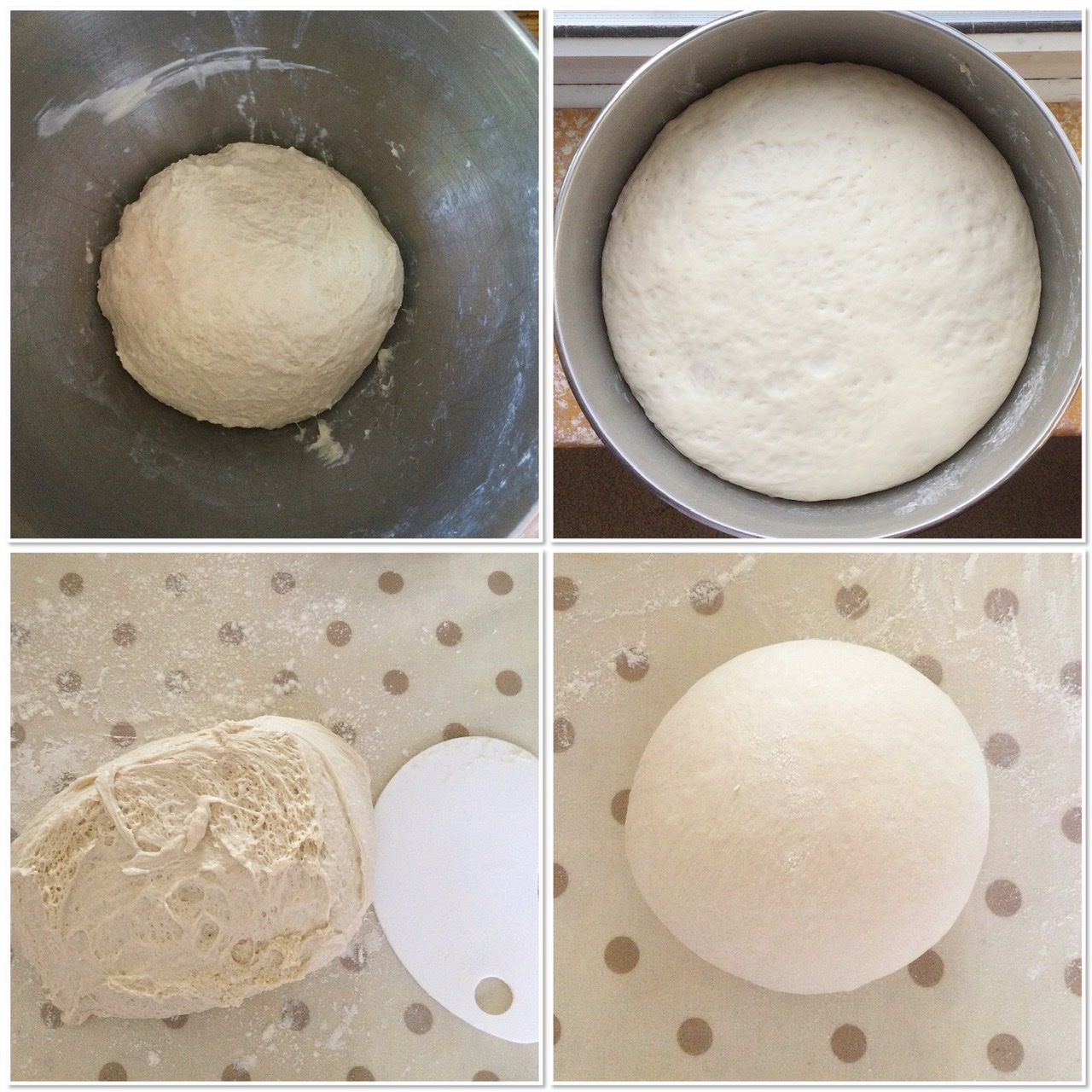
Four images showing dough being proved during bread making.Shaping The Dough

  • In the image above you can see the unshaped dough turned out of the bowl and a perfectly round, shaped dough ready for the second prove. The following steps will teach you how to shape and build tension across the dough so that it keeps it’s shape during baking.
  • First of all, dust your hands with flour.
  • Pull out part of the dough and then press it back into the centre. See the images below.
  • Turn the dough and repeat the last step. While you are doing this you are creating tension across the base of the dough.
  • Continue turning the dough, pulling and pressing into the centre until you have a tight, roundish shape.
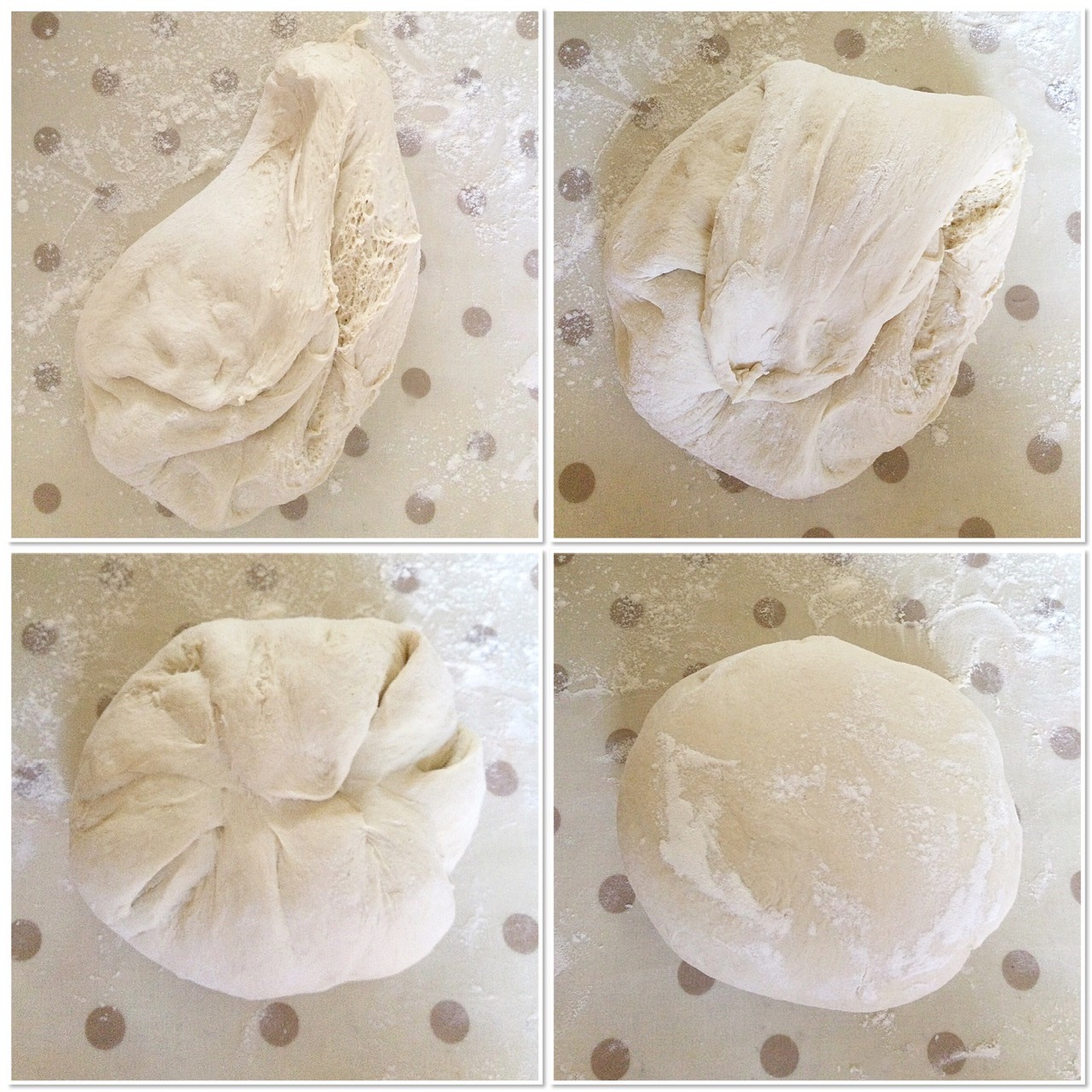
Four stages showing how to shape dough for a cob loaf.

Creating The Perfect Cob Loaf Shape

  • Flip the dough over and use your hands to cup and twist the dough.
  • Continue until you have a neat, tight, dough ball.
  • Finally place the dough ball onto a greased baking tray, cover with a tea towel and leave to prove for 20 minutes.
  • PRE HEAT your oven to 220C/200C fan, 425F, gas mark 7. Place a shallow, ovenproof dish with water in it on the bottom shelf of the oven.
  • After 20 minutes of proving use the blade of a sharp knife to score down the middle of the dough.
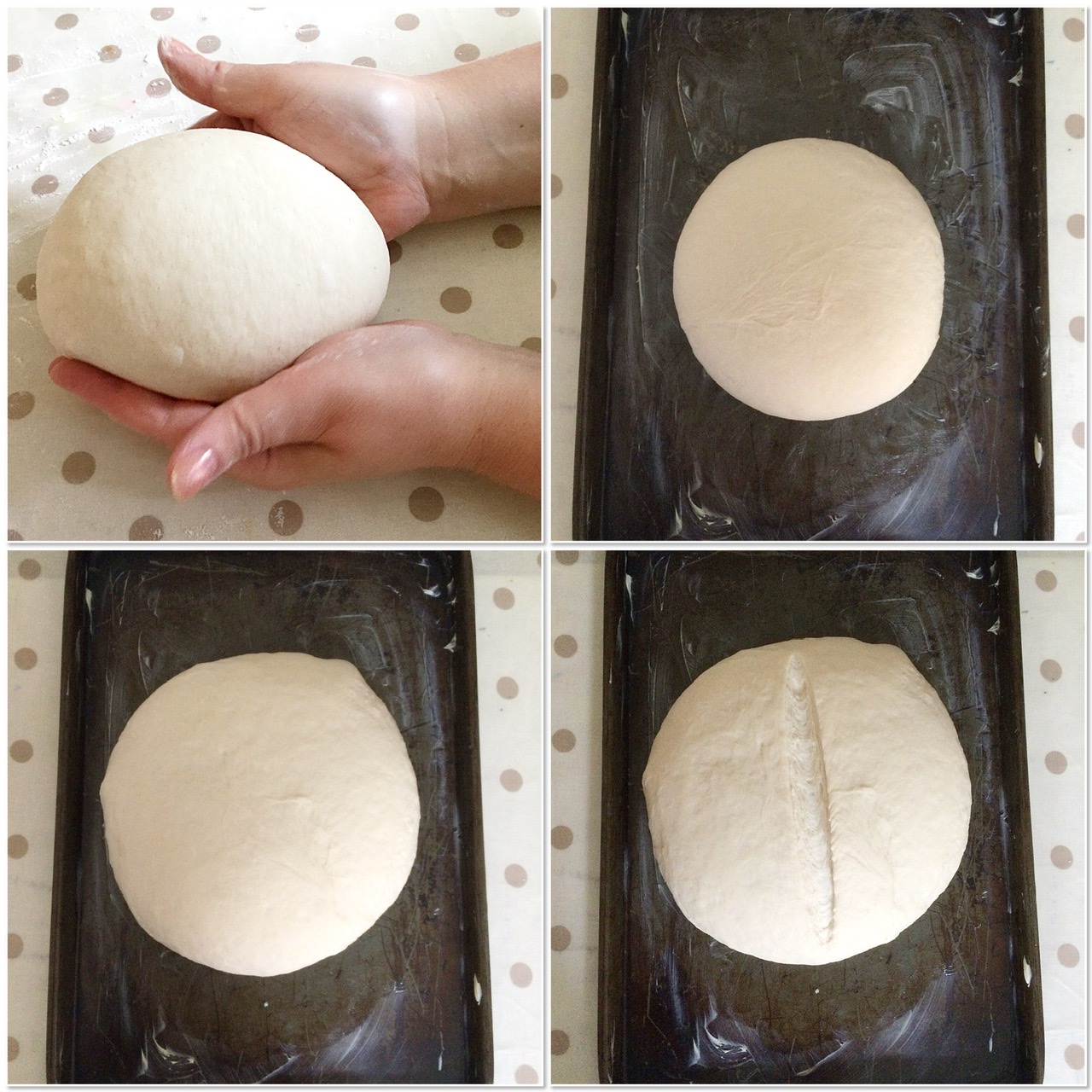
Shaping, proving and scoring dough for a cob loaf.

Baking The Easy White Cob Loaf

  • Preheating the oven with water in it creates a steamy environment that allows the dough to expand more before setting a crust.
  • Place the baking tray in the middle of the oven.
  • Bake the bread for 50-55 minutes.
  • The loaf should be golden in colour and sound hollow when rapped on the base with a knuckle (take care it will be hot).
  • As soon as the bread is baked remove it from the oven and place on a cooling rack or trivet to cool completely.
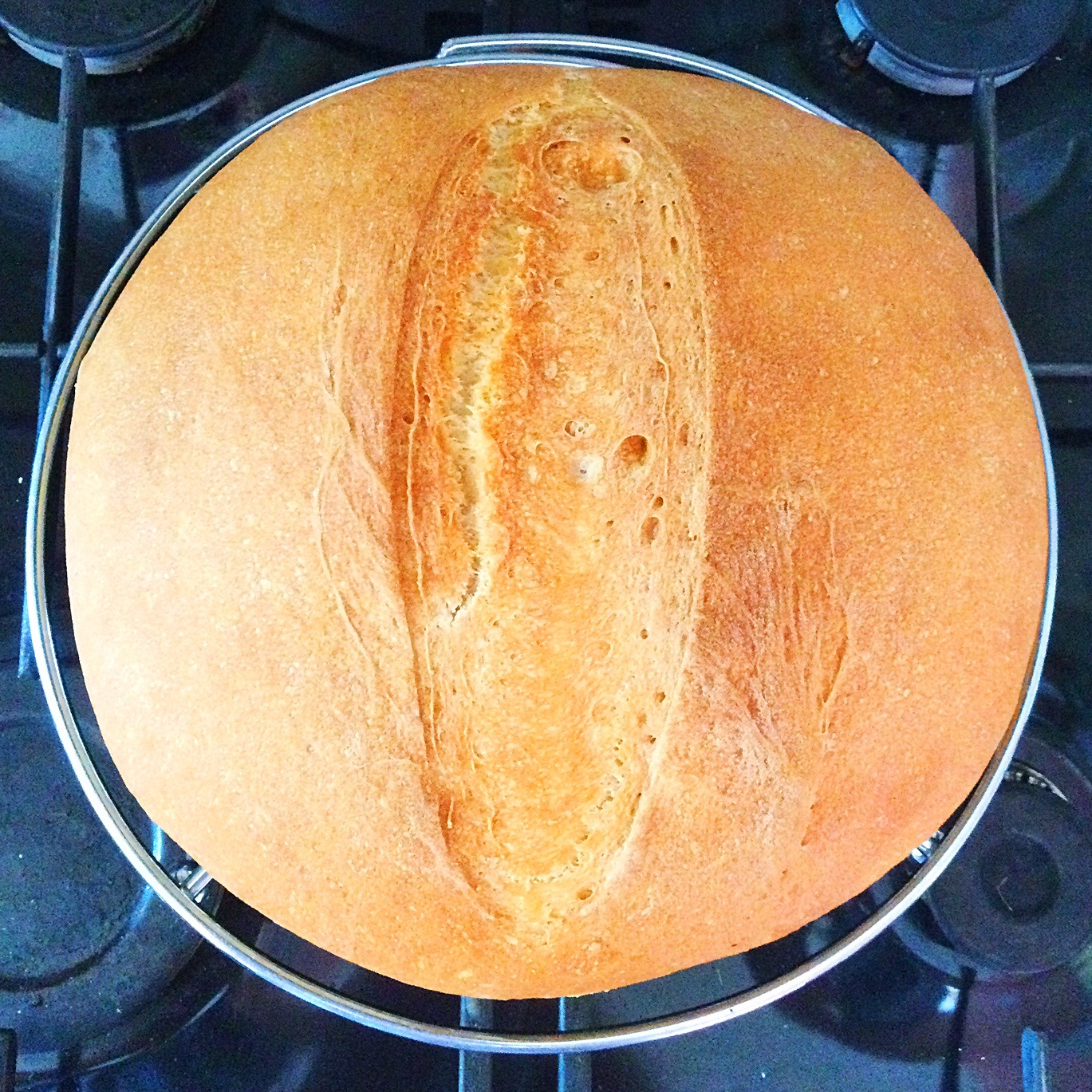
Freshly baked easy white cob loaf.

Leave the bread to completely cool before cutting it.
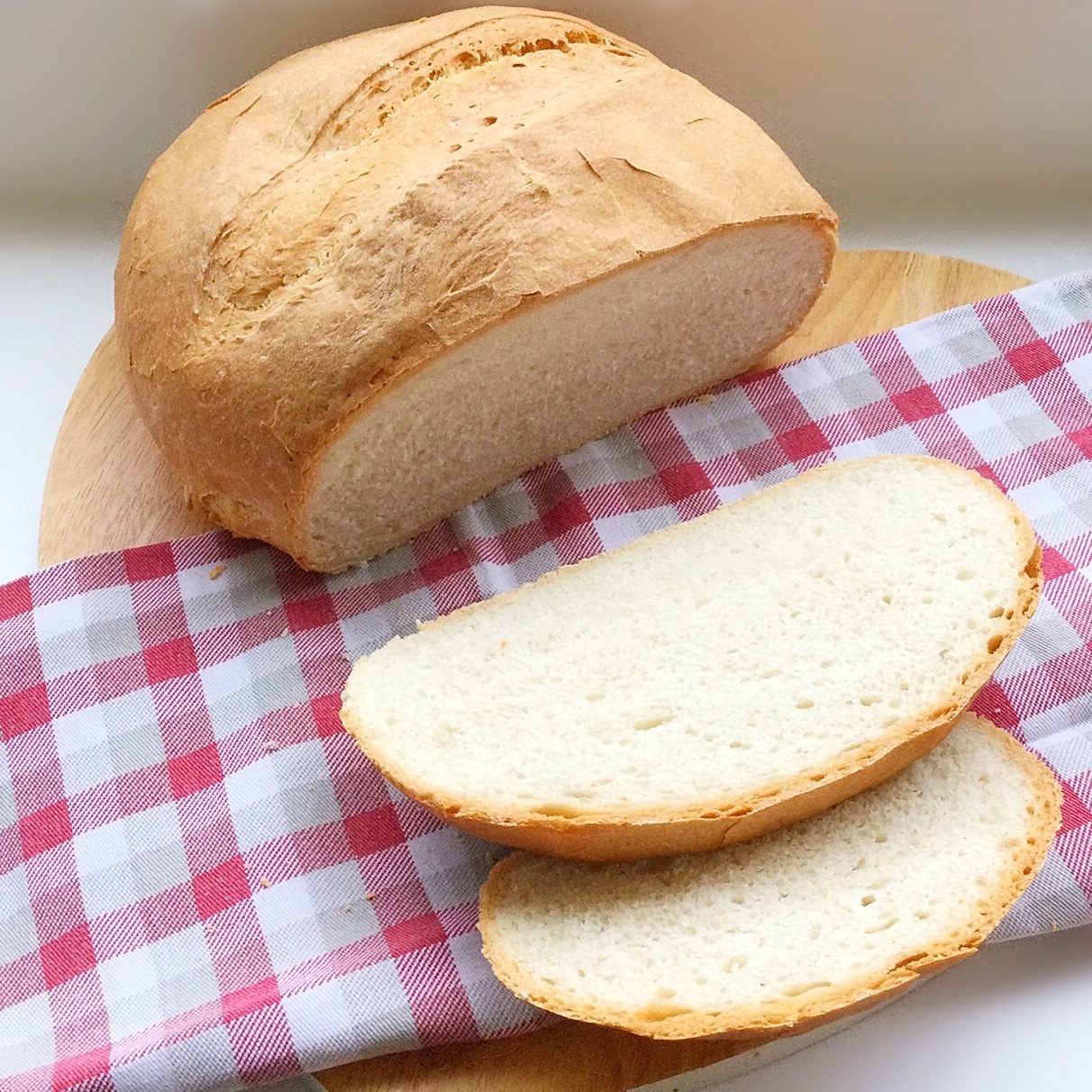
Easy white cob loaf sliced on a wooden board.

Attempting to cut hot or warm bread will cause it to lose it’s structure and collapse as it’s cut.
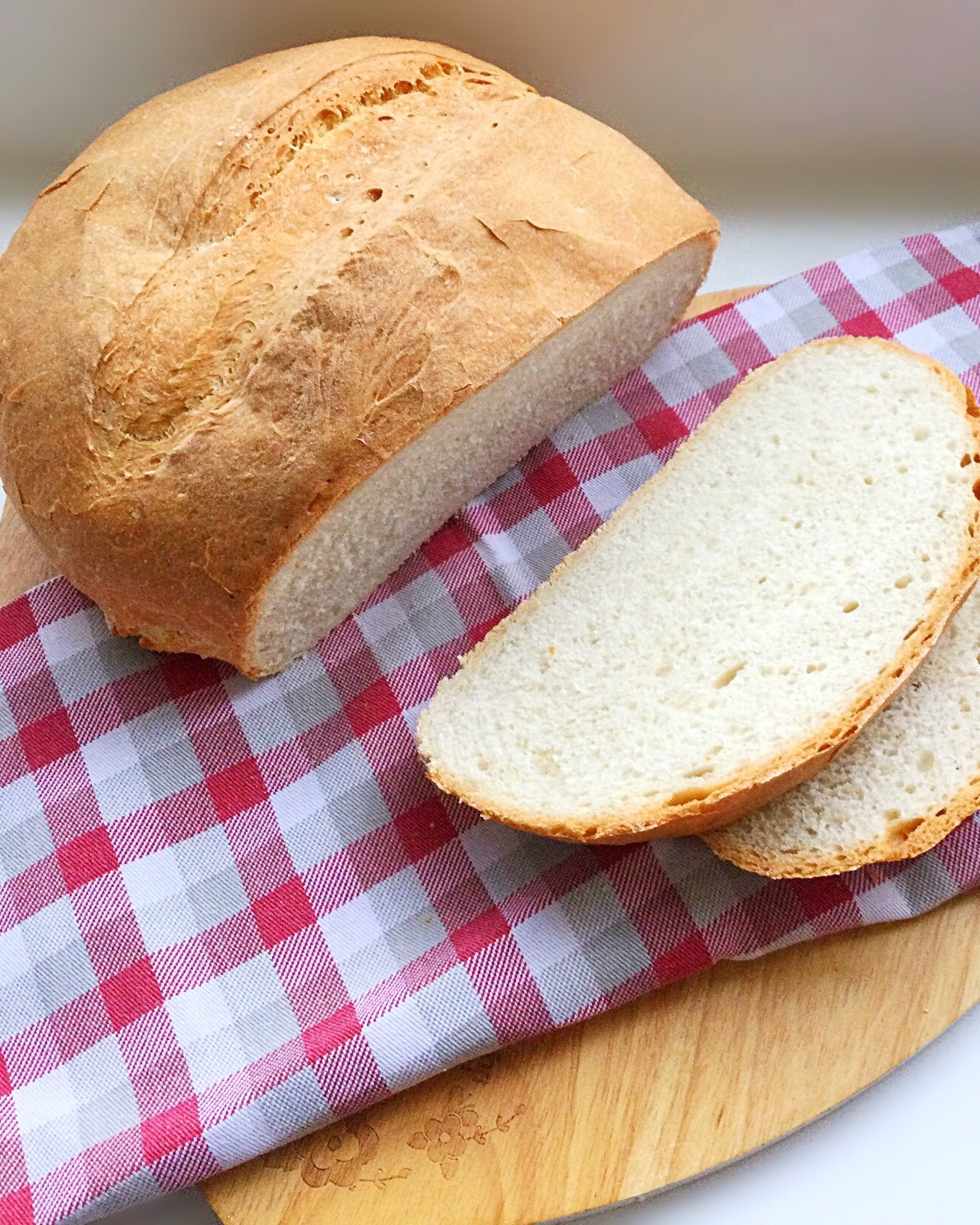
Easy white cob loaf - crusty bread sliced on a wooden board.

Beautiful, easy to cut, crusty bread.

If you have enjoyed this recipe for Easy White Cob Loaf you may also like these:
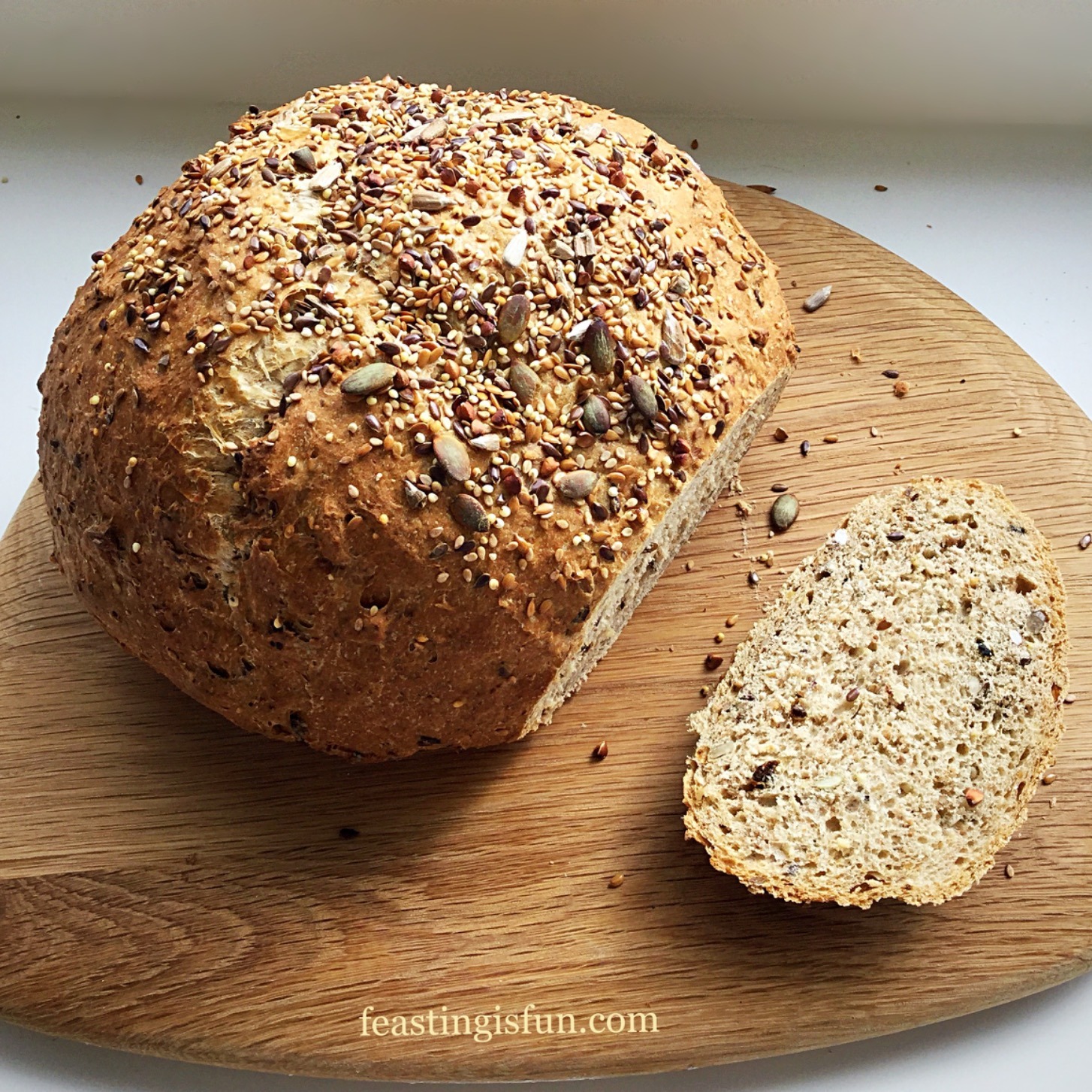
Seeded Cob Loaf

Seeded Cob Loaf on a wooden board.
Seeded Cob Loaf

Farmhouse White Loaf

Farmhouse White Loaf

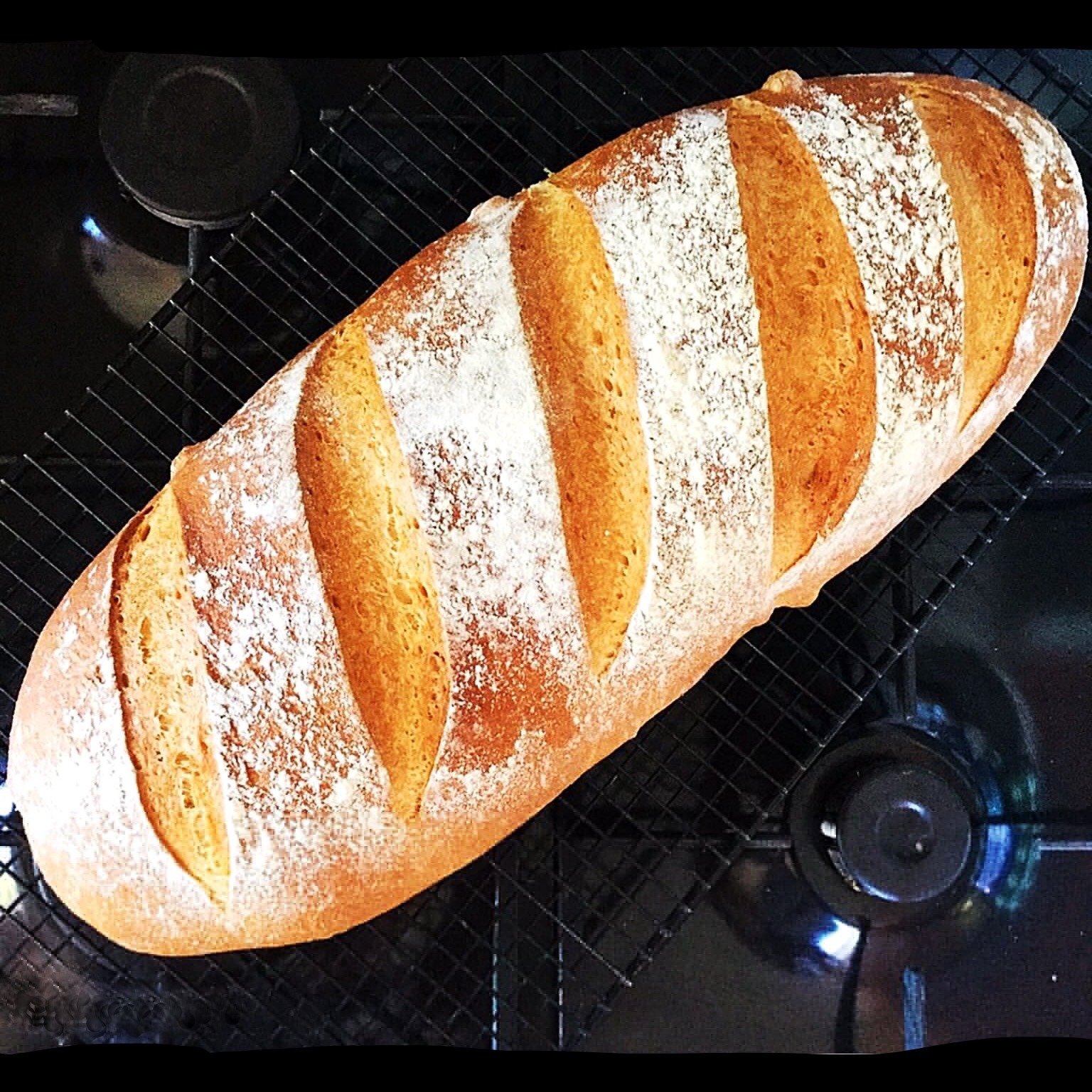
Large White Bloomer

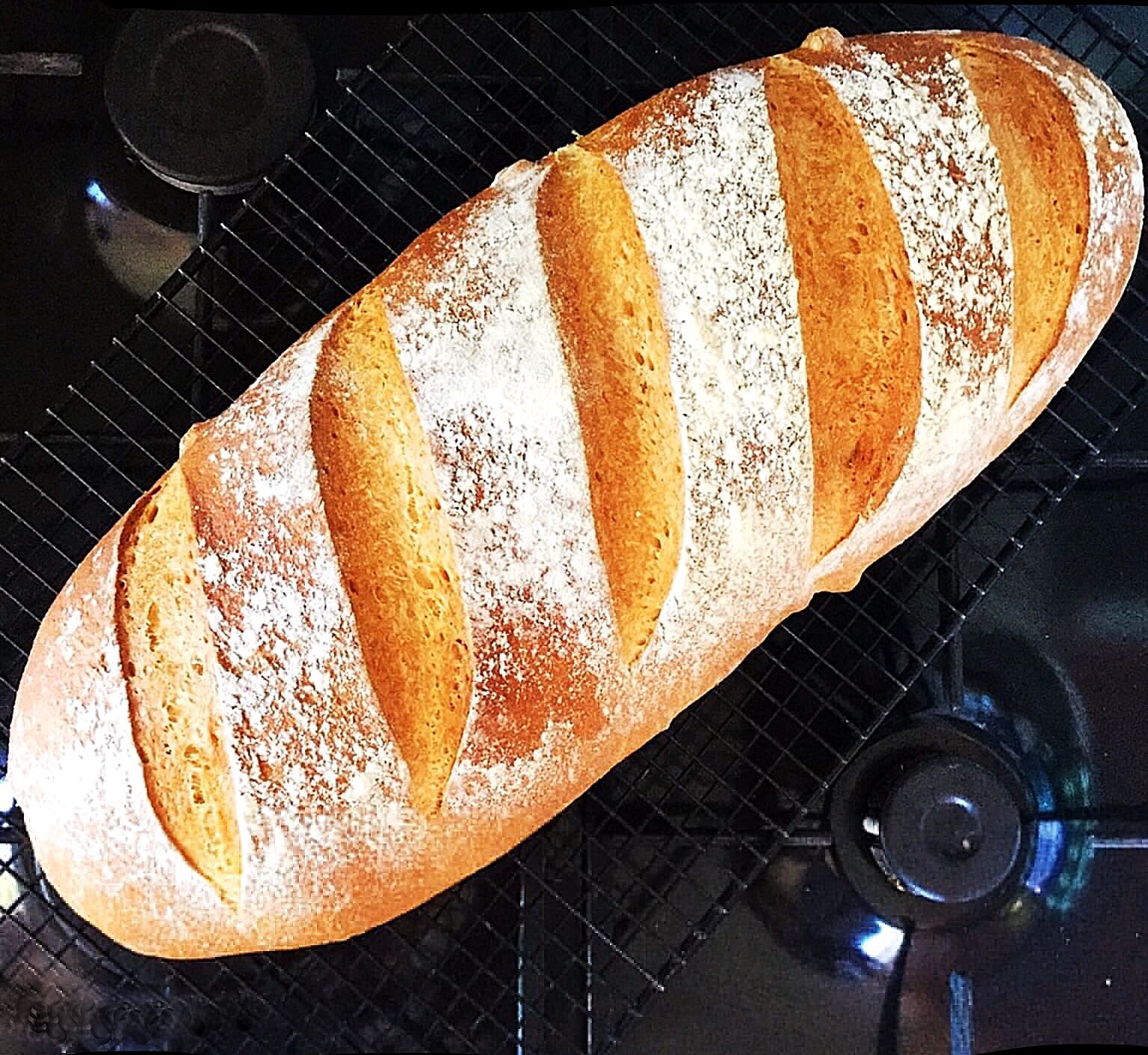
Large White Bloomer on a cooling rack.
Large White Bloomer

Since making bread is a passion of mine, sharing recipes, with you the reader, is important to me. Everyone who wants to should be able to make bread using simple, affordable ingredients. Equally important are clear, concise recipes with photographs. Together these aid confidence in the baker through each stage of the recipe, turning fear into fun!

So, whatever you are making, baking and creating in your kitchens, have fun preparing and sharing your feast.

Sammie x

No part of this post may be reproduced or duplicated without the written permission of the owner. Please see my Disclosure Policy.

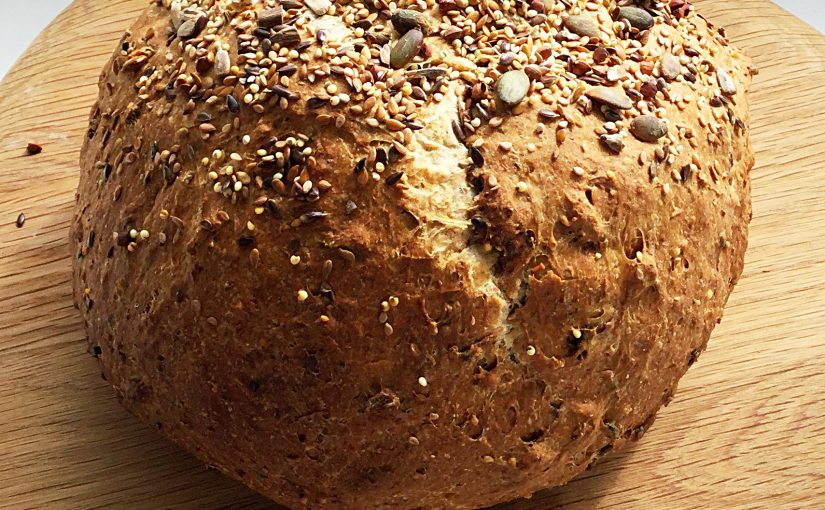
 

Seeded Cob Loaf

Bread is an everyday essential for most people in the Western world. And is available in different shapes, sizes and varieties. With the most popular bread, judging by the number of loaves sold each year, being sliced, predominantly white, plastic wrapped loaves. Yet what do offer in terms of flavour? In my opinion very little! Rather they are a carrier of flavours. Whether ham and mustard, egg and cress or the numerous filling combinations, the bread itself adds little to the taste or nutrition value of a sandwich. So, when you make this Seeded Cob Loaf, your world and tastebuds will open to the real flavour and texture of good, homemade bread.

FF Seeded Cob Loaf
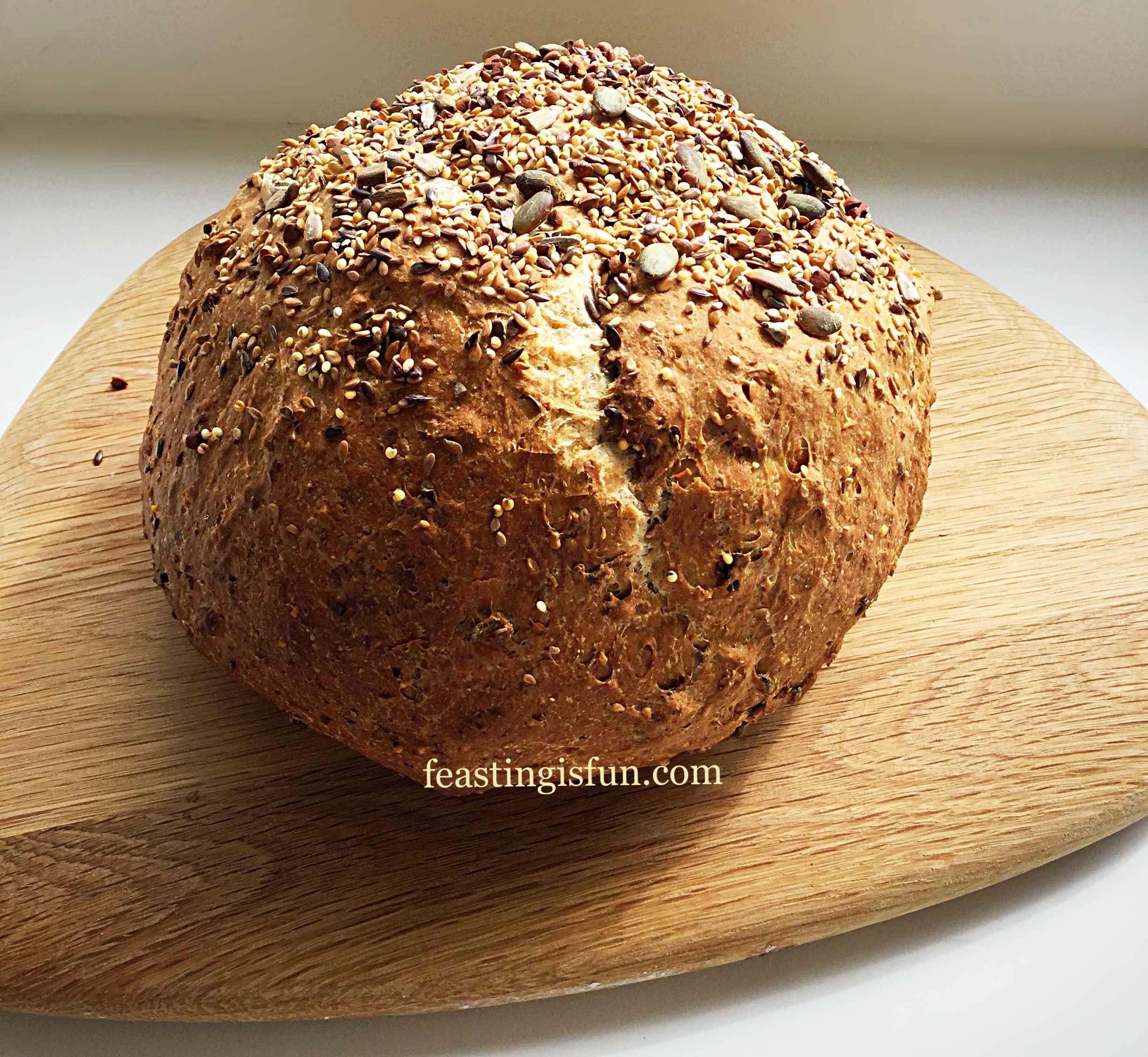
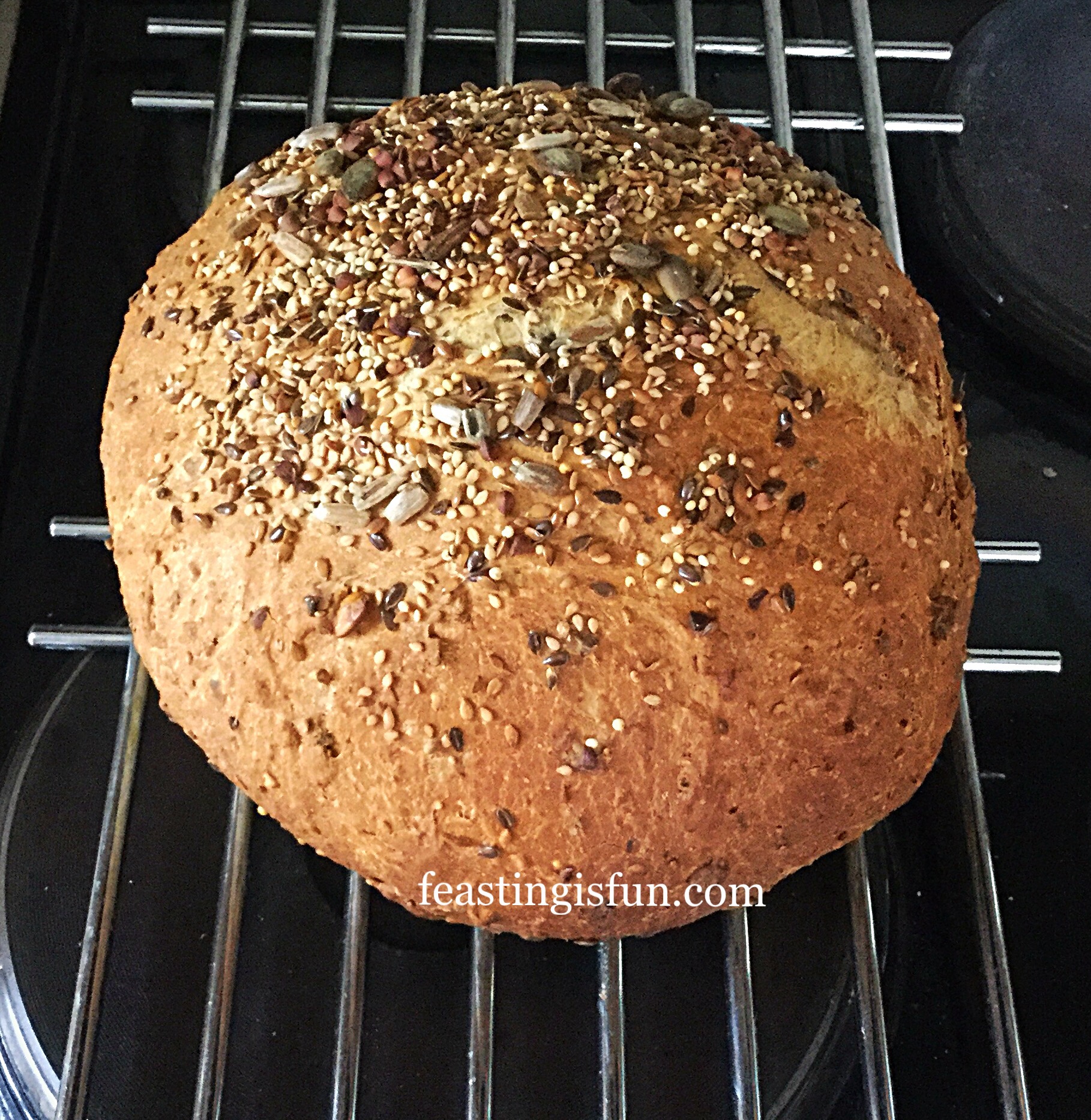
Seeded Cob Loaf full of flavour.

Seriously, this could be called ‘Change Your Life Seeded Cob Loaf.’ Because, as soon as you make it, with your own hands, bake and then try it, you will find it hard to go back to your usual loaf. Since it not only does it have incredible flavour, it’s cheaper, far healthier and more rewarding than plastic wrapped loaves.

FF Seeded Cob Loaf
Seeded Cob Loaf baked in a standard fan oven.

The Benefits Of Homemade Bread

Also, an important benefit from making bread at home, is that you, the baker, know exactly what goes into your bread. Flour, yeast, water, salt and a little unsalted butter. No preservatives, additives, flour improvers or any other number of E numbers found in mass produced bread. Simply a great tasting homemade loaf.

FF Seeded Cob Loaf
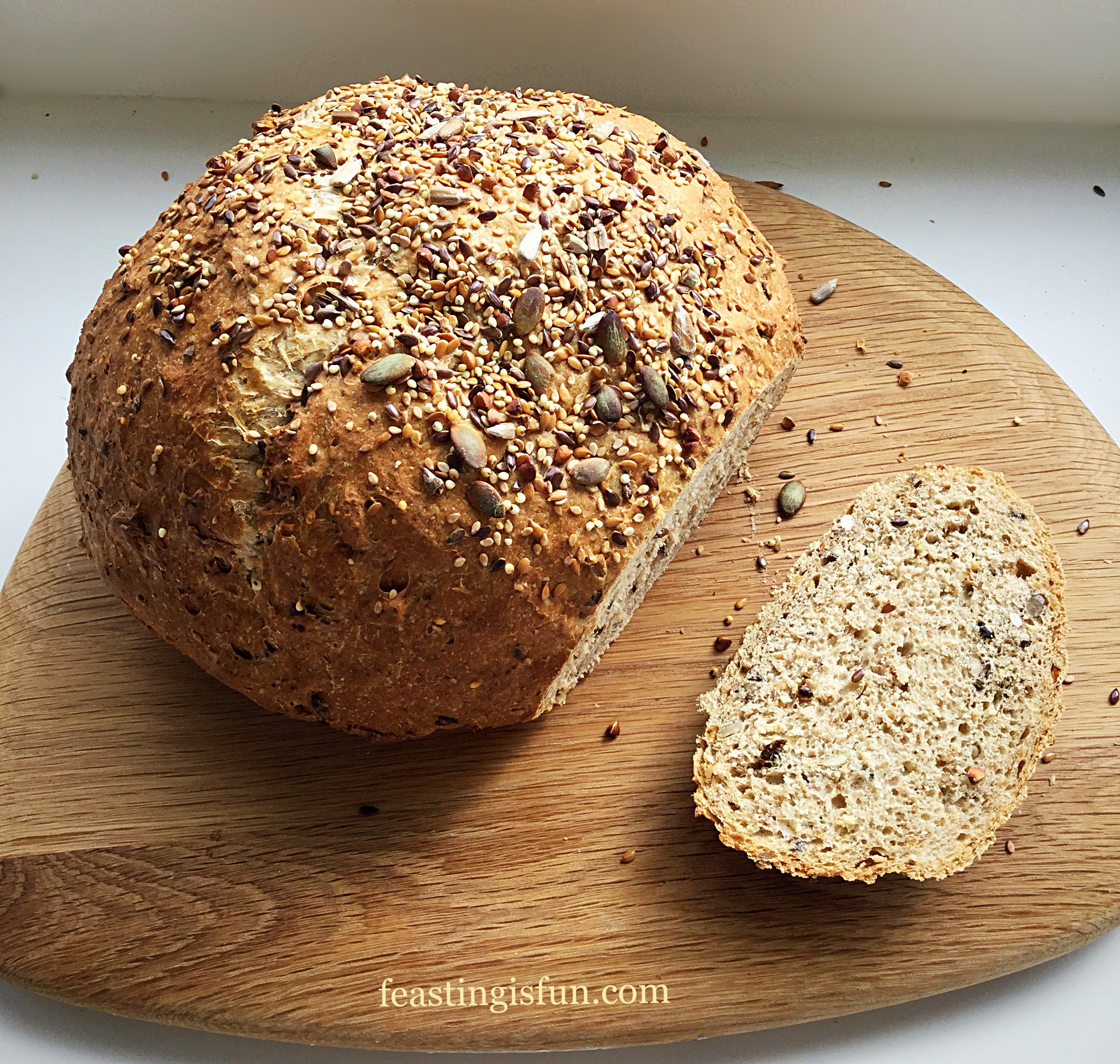
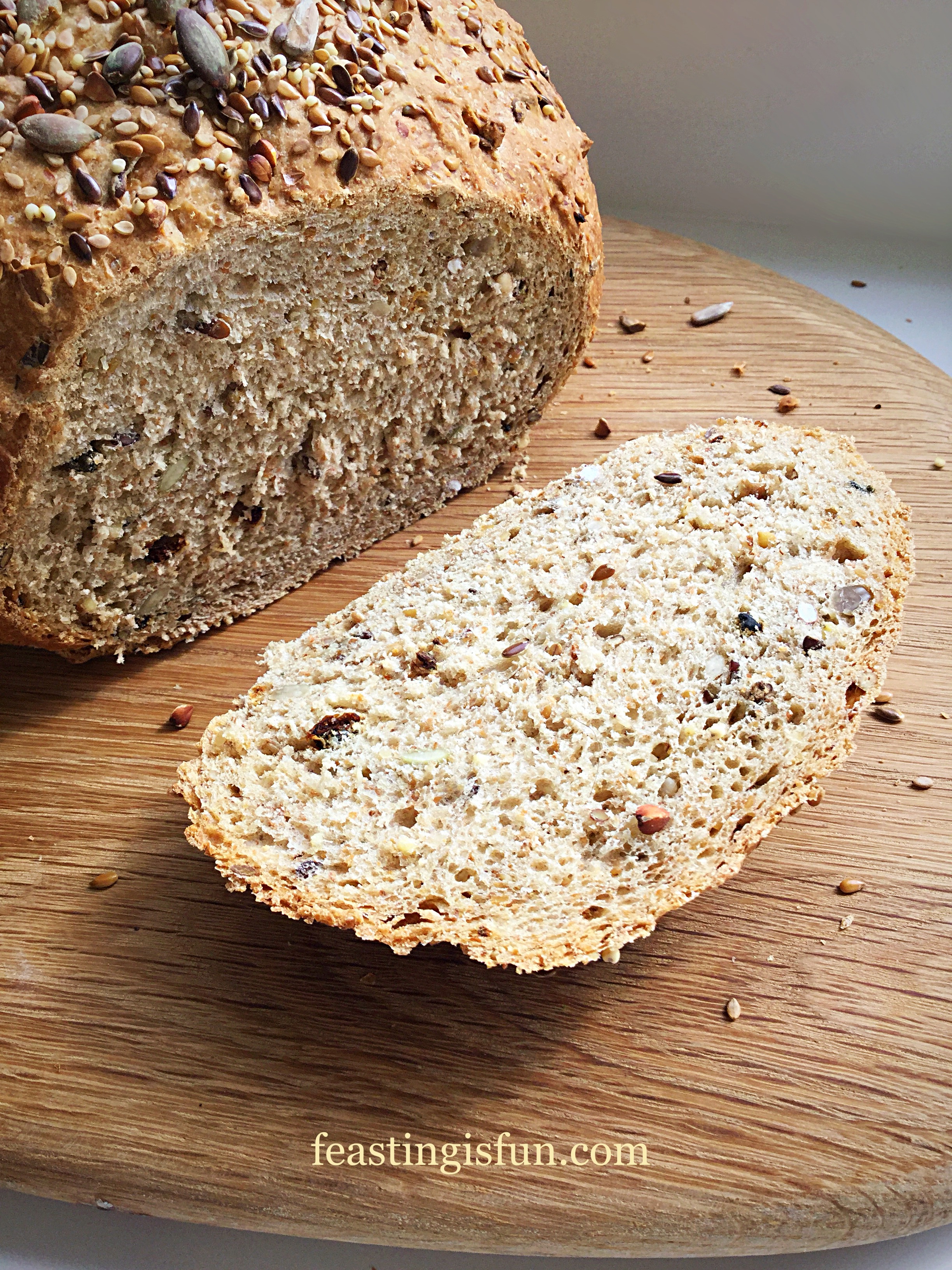
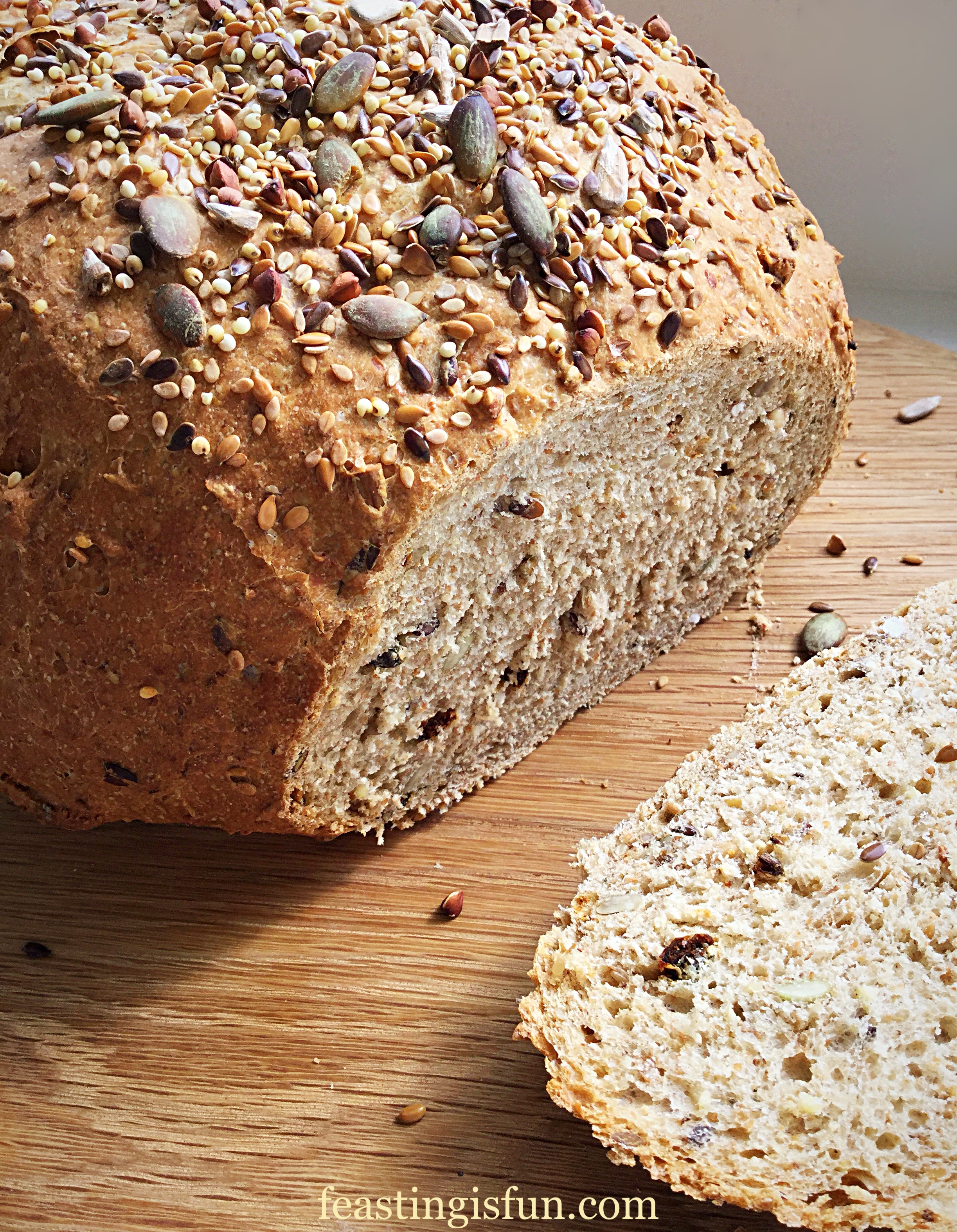
Sliced Seeded Cob Loaf.

Personally, this is one of the very best loaves I have made. Most importantly, I check my recipe twice, baking on two different days, to check consistency. Since tasting the first slice, lightly buttered, I have been eager to share this with you. Such is the depth of flavour and ease of shaping. Credit goes to Jack at Bake With Jack . Because watching his vlogs will improve both your knowledge and technique, when making bread at home.

Recipe: Makes 1 Seeded Cob Loaf

400g Wholemeal Seeded Bread Flour I use 3  Malts Sunflower from Shipton Mill – alternatively use half Wholemeal Bread Flour and half Strong White Bread Flour (250g + 250g = 500g total flour weight)

100g White Bread Flour (do not add if making your own flour mix – see above)

7g Fast Action Dried Yeast – I use Allinson’s

340mls Room Temperature Water

50g Mixed Seeds – plus a small handful for sprinkling on the loaf

30g Softened Unsalted Butter

7g Salt – I use Maldon

Method: I use a stand mixer fitted with a dough hook, alternately this bread can be made by hand.

Note: For complete accuracy the use of digital scales is advised. Even for weighing water, 1ml is equivalent 1g.

Making The Seeded Cob Loaf Dough Using A Stand Mixer

  • Into the bowl of the stand mixer weigh the water and yeast.
  • Next, add both flours and the additional 50g of seeds, even if you are using seeded flour.
  • On top of the flour add the salt and cubed butter.
  • Lower the dough hook and mix on slow for 5 minutes, then increase the speed and mix for a further 5-10 minutes on medium. The dough is ready when it can be stretched without tearing and light can be seen through the stretched dough. This is known as the windowpane test.
  • Use clean hands to scrape any dough stuck to the dough hook back into the bowl.
  • Cover the bowl with a clean tea towel and place on a surface that is draught free.
  • Leave the dough to prove until doubled in size. This may take between 1-2 hours, depending on the room temperature.
  • While the bread is proving, grease a large baking tray with a little butter.

Knocking Back And Shaping The Dough

  • After proving scatter a very small amount of flour on to the work top.
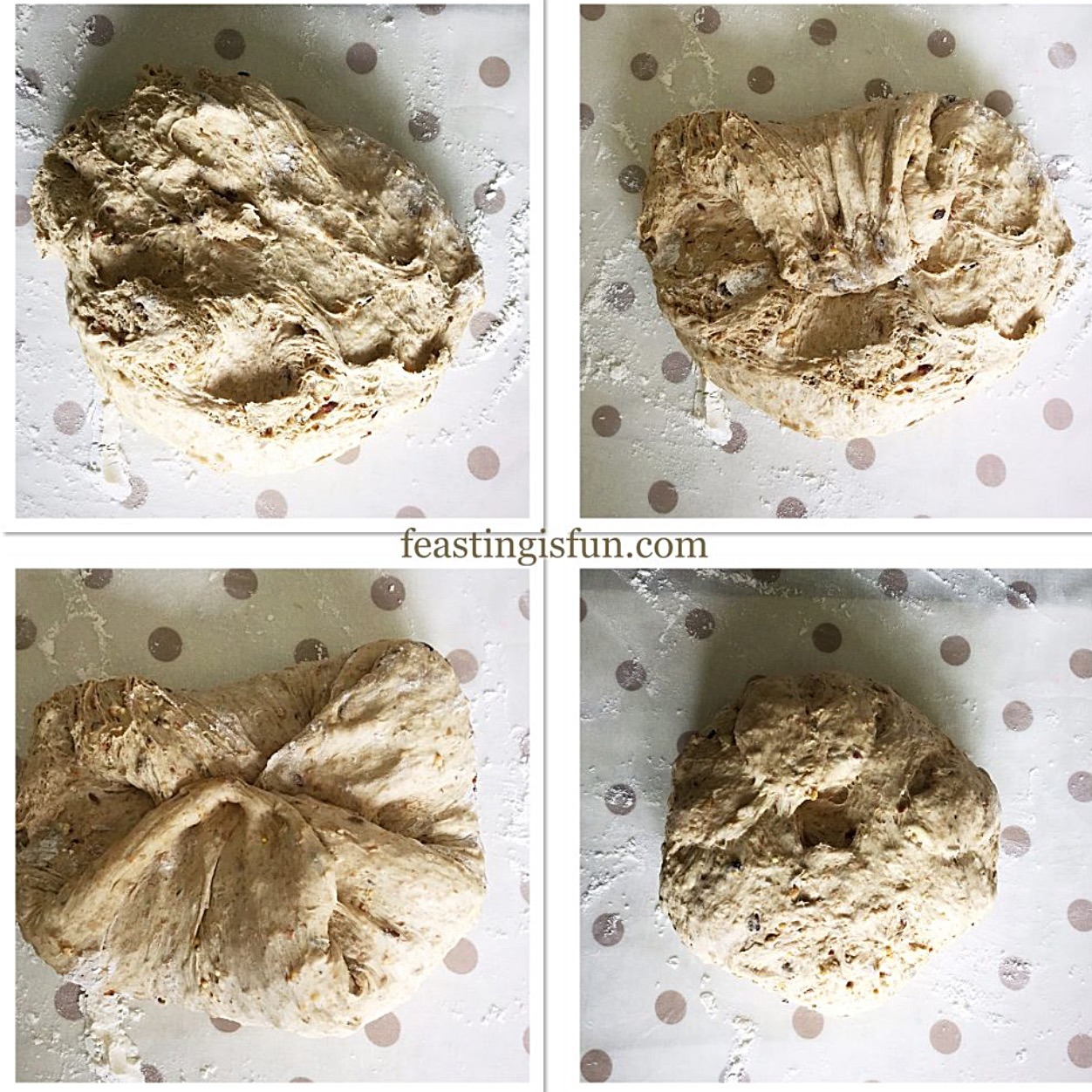
  • Turn out the dough ensuring the domed top becomes the bottom and the sticky underneath is uppermost.

Shaping bread dough into a round.

  • Following the pictures above, shape the dough. First pull the edge of the dough and press it down into the sticky centre. Continue, working around the edge of the dough, pulling out and pressing in. While doing this, tension is being built across the top of the loaf, (the underneath of the dough), this helps ensure a tight ball shape that doesn’t collapse whilst proving or baking.
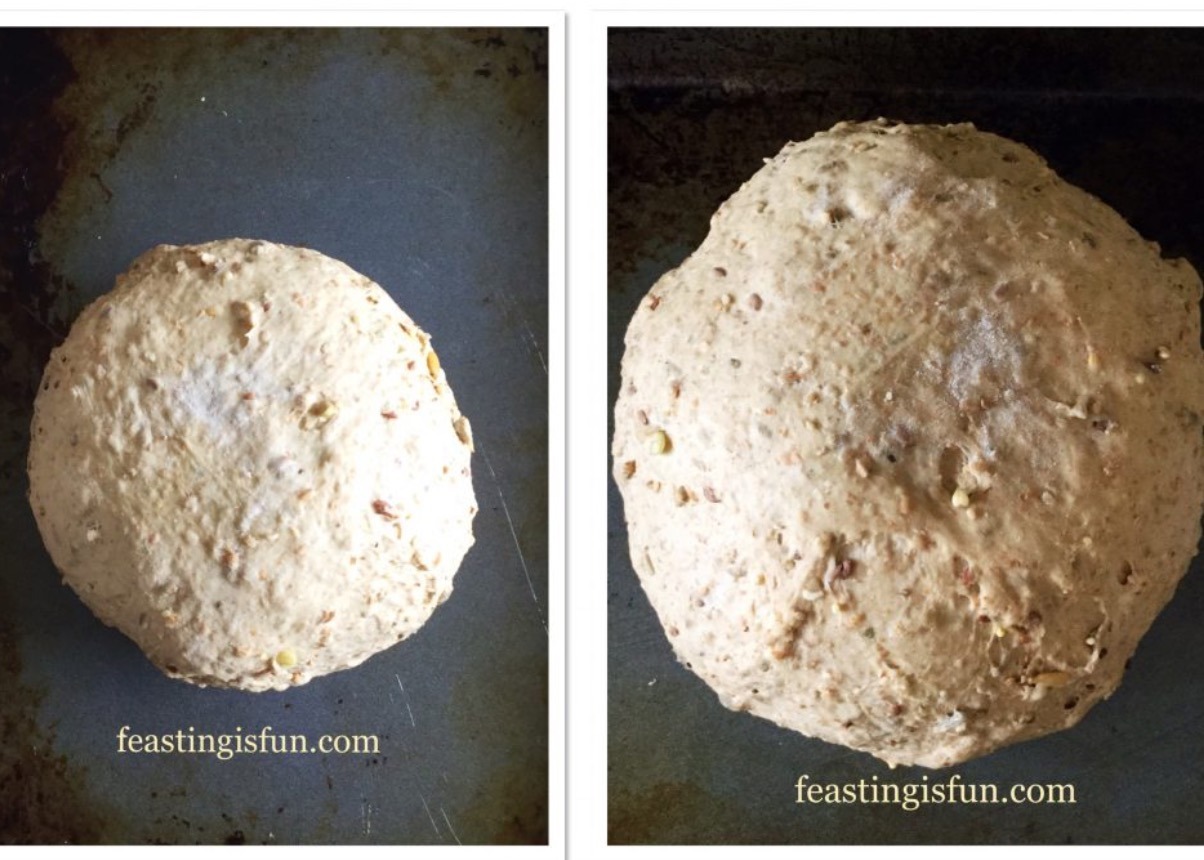
  • Keep working around the edge of the dough until you achieve a tight ball, as seen in the left of the photo below.

Dough before and after the second prove.

  • Cover the dough ball with the tea towel and leave until doubled in size. See photo above on the right.

Baking The Cob Loaf

  • While the dough is undergoing its second prove Preheat the oven to its hottest setting. Add a tray of water to the bottom of the oven. Since adding water provides steam which helps the dough to rise (oven spring) before forming a crust.
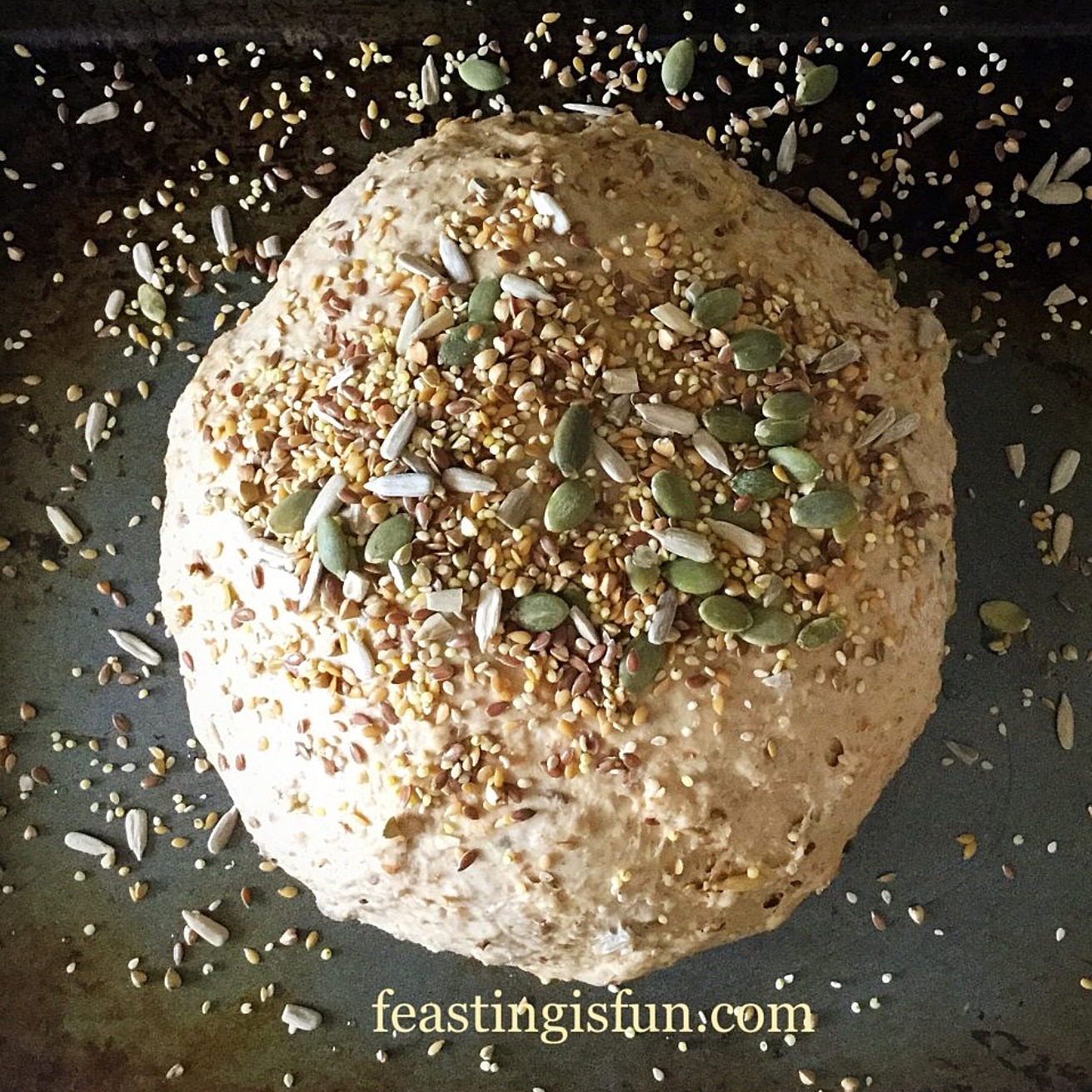
  • As soon as the dough has doubled in size, it is ready to bake. Remove the tea towel and brush the top of the dough with water. Then sprinkle over the remaining seeds.
Round bread dough ready to be baked.
Seeded Cob Loaf ready for the oven.
  • Place the seed covered loaf into the middle of the oven.
  • Immediately reduce the temperature of the oven to 220C/200C fan, gas mark 7, 425F . Note – the reduction in heat stops the seeds from burning.
  • Bake for 45 minutes, remove from the oven. Take the loaf off of the baking tray and place back in the oven, directly on to the oven shelf. Continue baking for 10-20 minutes, depending on how crusty you want your bread.
  • As soon as the bread is done, remove it from the oven and place on a cooling rack.
FF Seeded Cob Loaf
Seeded Cob Loaf cooling on a rack.
  • Ensure the loaf is completely cooled before slicing.

FF Seeded Cob Loaf

Perfect for slicing, packing up with an assortment of fillings and taking on a picnic. Alternatively simply tear into chunks and dunk in warming bowls of soup.

FF Seeded Cob Loaf

If you have enjoyed this recipe for Seeded Cob Loaf then you may also like these:

Farmhouse White Loaf

Farmhouse White Bread
Farmhouse White Loaf


Large White Bloomer

Crusty White Bloomer Bread
Large White Bloomer

Easy White Cob Loaf

Easy White Cob Loaf sliced on a wooden board
Easy white Cob Loaf

I find baking at home an immensely fulfilling experience. Especially the tempting aroma as a beautiful bread in baking in the oven. And if your first loaf isn’t the perfect shape, it’s taste will more than make up for its appearance. So, keep practicing and your technique will improve! Finally, baking bread at home will give you a delicious loaf and a sense of accomplishment.

Have fun, making, creating and baking in your kitchens.

Sammie xx

Please see my Disclosure Policy regarding copyright and intellectual property laws, before reproducing any copy from this blog.